we toured greece last month. i am fascinated by columns.
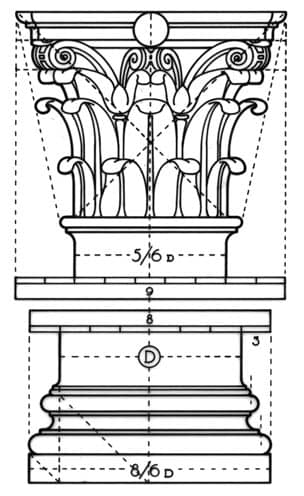
the illustration of a Corinthian column by Randal Birlkey leaves certain dimensions missing. The column has a diameter “D” at the base of the the round column but then flares out to a larger diameter “D+” about 1/3 of the height of the column before tapering down to “5/6 D” at the top or the column. Is the column taper cut from a circle, a parabola or what?
I visited Greece the summer of 1980, and am planning to visit again within the next few years. I find Greek culture and architecture fascinating. There is no better food either!
Many early Greek columns were constructed out of a single piece of stone shaped on a lathe-like apparatus ( see example of a Greek Doric column made this way). Other stone columns like the illustration were created out of multiple sections of stone fitted together. Often these sections had a center hole so that they could be aligned and pinned together. The reason for the entasis (the inclusion of a slight outward curve in the sides) plus a reduction in diameter along the height of the column, is to make the columns stronger, and appear taller to the human eye.
we toured greece last month. i am fascinated by columns.
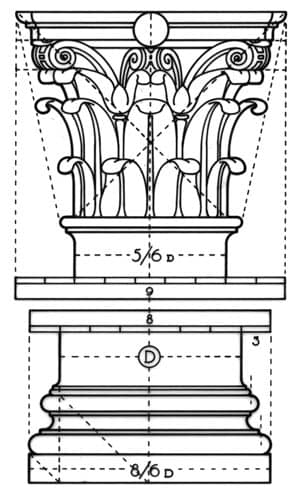
the illustration of a Corinthian column by Randal Birlkey leaves certain dimensions missing. The column has a diameter “D” at the base of the the round column but then flares out to a larger diameter “D+” about 1/3 of the height of the column before tapering down to “5/6 D” at the top or the column. Is the column taper cut from a circle, a parabola or what?
respectfully,
michael cox
Michael,
I visited Greece the summer of 1980, and am planning to visit again within the next few years. I find Greek culture and architecture fascinating. There is no better food either!
Many early Greek columns were constructed out of a single piece of stone shaped on a lathe-like apparatus ( see example of a Greek Doric column made this way). Other stone columns like the illustration were created out of multiple sections of stone fitted together. Often these sections had a center hole so that they could be aligned and pinned together. The reason for the entasis (the inclusion of a slight outward curve in the sides) plus a reduction in diameter along the height of the column, is to make the columns stronger, and appear taller to the human eye.
Glad you found the illustration interesting.
Regards,
Randal